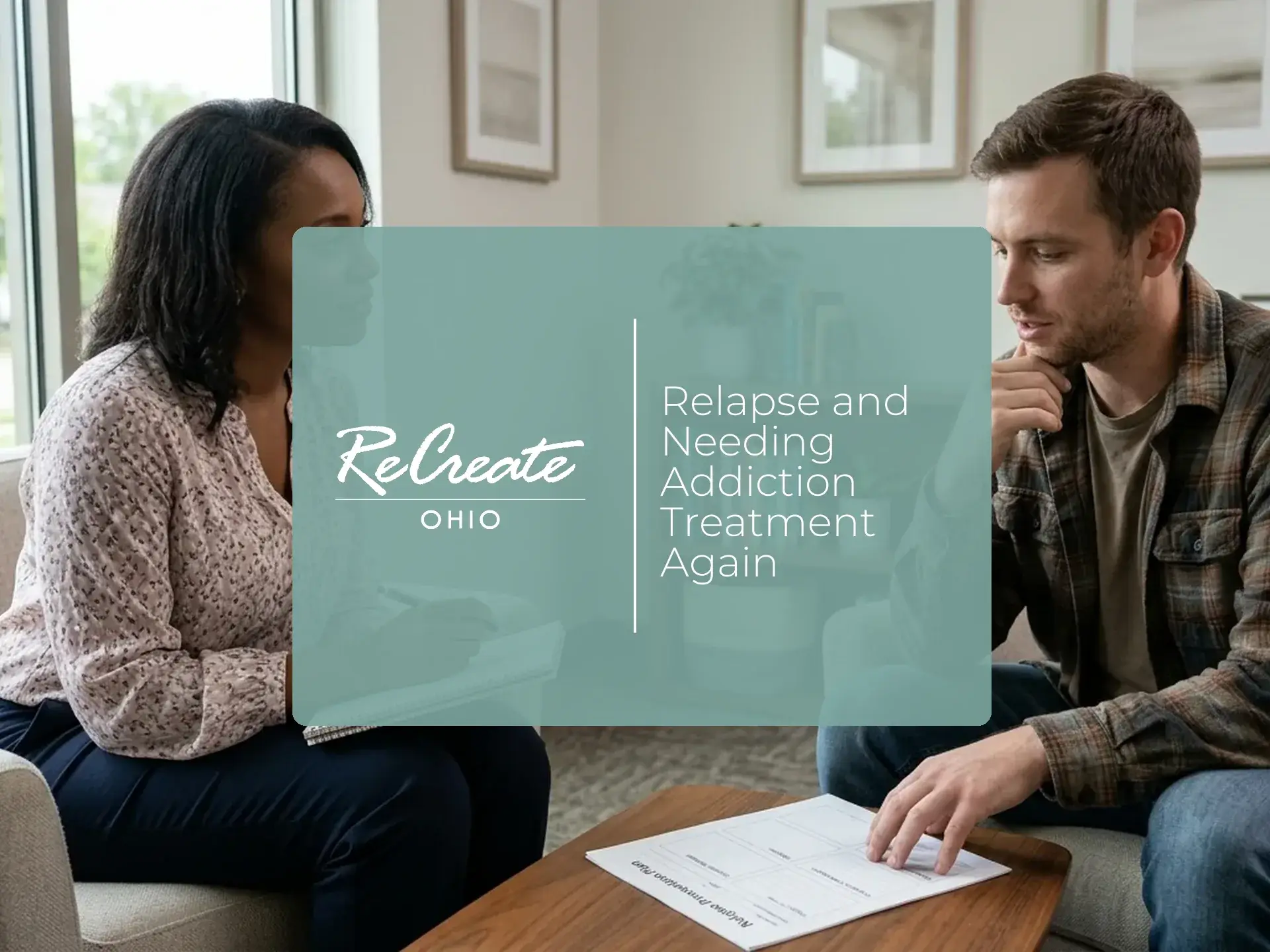
You did the program. You went to detox, maybe residential, maybe both. And now you’re using again, or someone in your family is, and the shame of that is sitting on your chest like a weight that wasn’t there before. You keep asking the same question at 2 a.m. (and yes, it really can feel that specific and that lonely): does this mean it didn’t work? Does this mean you’re a lost cause?
It doesn’t. Needing addiction treatment again after a relapse is common, medically expected, and not a sign of failure. Addiction is a chronic disease, and like other chronic diseases, it can flare up even after a person has done real work toward recovery. Returning to treatment is simply the next right step.
Recreate Behavioral Health of Ohio treats relapse as a clinical event. We built our medical detox and residential programming around the reality that recovery isn’t a straight line for most people who walk through our doors, and that returning for another round of care often requires a different plan than the first time. Recreate Ohio holds a primary mental health license from the state of Ohio alongside our addiction treatment services, which matters here because relapse and co-occurring mental health conditions are so often connected. Located in Gahanna, Ohio, just minutes from Columbus, we work with adults from across Central Ohio and the Midwest who are coming back to treatment, some for the second time, some for the fourth, all of them still worth the effort.
Is It Normal to Need Help Again If Addiction Treatment Didn’t Work the First Time?

Yes, it’s normal, and it’s far more common than most newcomers to recovery expect. Research on chronic diseases, including addiction, consistently shows that relapse rates for substance use disorders are comparable to relapse rates for conditions like hypertension and asthma, somewhere in the range of 40 to 60 percent. That statistic shows that your first treatment experience was a necessary piece of a longer process.
Think about what actually happens in early recovery. You’re rewiring thought patterns and behaviors that may have taken years to build. You’re often doing this while your body is still healing and your brain’s chemistry is still recalibrating. Expecting one 30-day stay to permanently undo all of that isn’t realistic, and it was never the right bar to measure treatment against in the first place.
What does matter is what you do next. Treatment programs can, and should, change based on what the first attempt revealed. Maybe the first round didn’t address an underlying mental health condition. Maybe the discharge plan didn’t include enough step-down support. Maybe you simply needed more time. That makes you someone with more information than you had before.
What Are the Three Types of Relapse?

Clinicians generally describe relapse in three stages: emotional, mental, and physical. Emotional relapse happens first, often weeks before any substance use returns, and looks like isolation, poor self-care, and bottled-up emotions. Mental relapse follows, marked by internal conflict between wanting to use and wanting to stay sober. Physical relapse is the actual return to drinking or drug use.
That staging matters for you or your family. If relapse is a process rather than a single moment, there’s a window, sometimes a fairly wide one, where intervention can happen before substance use ever restarts. Recognizing emotional relapse (withdrawing from friends, skipping meetings, bottling up stress) gives you or a loved one a chance to reach out for support before things escalate to physical relapse.
| Stage | What It Looks Like | What Helps |
|---|---|---|
| Emotional Relapse | Isolation, poor sleep, skipping support meetings, mood changes | Reconnecting with support systems, therapy check-ins, honest conversations |
| Mental Relapse | Craving substances, romanticizing past use, bargaining internally | Coping skills from CBT or DBT, calling a sponsor or counselor, structured routine |
| Physical Relapse | Actual drinking or drug use resumes | Immediate medical evaluation, possible detox, reassessment of the treatment plan |
Each stage is further from the exit and closer to crisis. Catching it early changes everything about what treatment needs to look like next.
What Is the Number One Cause of Relapse?
Stress is widely cited as the single most common trigger for relapse, often tied to unresolved emotional pain, untreated mental health conditions, or sudden life disruption. Job loss, a relationship ending, grief, financial pressure (this is where most people get caught off guard): these are the forces that most frequently push someone back toward the substance that once offered relief.
But stress rarely acts alone. For many people, stress reveals a mental health condition that was never fully addressed in a prior treatment episode. Anxiety that was never treated. Depression that got labeled “just stress.” Trauma that surfaced in therapy but wasn’t worked through before discharge. This is exactly why dual diagnosis care matters so much in a second or third round of treatment. Treating the addiction without treating what’s underneath it leaves the door wide open for the same cycle to repeat.
What Are Relapse Justifications?
Relapse justifications are the internal explanations a person constructs to make returning to substance use feel acceptable or even reasonable. “I’ve earned one drink.” “I can handle it now.” “It’s just this one time, because of what happened today.” These thoughts tend to show up during the mental relapse stage, before any substance use occurs, and they are a recognizable warning sign rather than a personal weakness.
Recognizing these justifications as a symptom of the disease process is part of what good relapse prevention planning teaches. If you’ve caught yourself building one of these arguments in your own head, or heard one from someone you care about, that’s a signal worth acting on, not ignoring.
Common relapse justifications include:
- “I’ve been sober long enough to have just one.”
- “This situation is different. I’m in control this time.”
- “Nobody will know, and it won’t hurt anyone.”
- “I deserve this after everything I’ve been through.”
- “I can stop again whenever I want to.”
Every one of these thoughts sounds reasonable in the moment. That’s what makes them dangerous, and that’s exactly why a strong aftercare plan addresses them directly rather than assuming willpower alone will carry someone through.
Client Spotlight
A woman named Priya came back to Recreate Ohio about eight months after completing her first residential stay for alcohol use disorder. She’d stayed sober for several months, then a divorce finalized and the isolation crept in fast. By the time she called, she’d already had two drinks the night before and was terrified she’d blown everything. Her new treatment plan looked different the second time: individual therapy focused on the grief underneath her drinking, group sessions built around managing major life transitions, and a step-down plan connecting her to a therapist near her home before she ever left our campus. She told our team that the second round felt like finally getting the plan she’d actually needed from the start.
What Are the Signs and Symptoms of Dual Diagnosis?
Dual diagnosis, also called co-occurring disorders, describes the presence of both a substance use disorder and a mental health condition at the same time. Signs often include using substances to manage mood swings, anxiety, or intrusive thoughts; mental health symptoms that worsen during withdrawal; and a pattern where treating one condition alone never seems to fully resolve the other.
Specific signs vary by condition, but common patterns include:
- Persistent low mood or hopelessness alongside substance use
- Panic, racing thoughts, or hypervigilance that predates or follows periods of use
- Dramatic highs and lows in energy or behavior
- Flashbacks, nightmares, or avoidance behaviors tied to past trauma
- Difficulty sleeping that doesn’t improve even with sustained sobriety
- A pattern of relapse that seems tied to specific emotional triggers rather than random circumstance
If any of that sounds familiar, either in yourself or in someone you’re worried about, it’s worth raising directly with a clinician during intake rather than waiting for it to surface later. Co-occurring conditions are the rule in addiction treatment, and they’re a major reason relapse happens even after a genuinely good first treatment experience. At Recreate Behavioral Health of Ohio, every treatment plan screens for this connection from day one, because addressing addiction without addressing the mental health condition driving it rarely holds up over time.
What Is the Average Survival Rate for Individuals With Addiction?
There’s no single national “survival rate” statistic for addiction the way there is for some illnesses, because outcomes depend heavily on the substance involved, access to treatment, and whether co-occurring conditions are addressed. What’s well documented is that substance use disorders, especially those involving opioids and alcohol, carry serious mortality risk when left untreated, and that engagement in treatment, including repeated treatment episodes, measurably improves long-term survival and recovery outcomes.
This is part of why returning to treatment after a relapse is protective. Every treatment episode, even one that doesn’t lead to permanent sobriety, builds skills, strengthens support systems, and reduces risk. You’re reducing your risk every time you come back.
What Is the New Term for Relapse?
Many clinicians now use the phrase “return to use” instead of relapse, partly to reduce the stigma and sense of failure attached to the older term. Some professionals also describe it simply as a “recurrence of symptoms,” framing it the same way a doctor would describe a flare-up of any other chronic illness.
Language matters here. Calling it a “return to use” instead of a “relapse” reframes what happened as a medical event rather than a moral one. Your disease, left without enough support in a given moment, did what chronic diseases do. That distinction changes how you talk to yourself about what comes next, and it should.
What Do You Say to Someone Who Relapsed?

The most helpful response is honest, calm, and free of shame: acknowledge what happened without minimizing it, and ask what they need right now rather than cataloging what went wrong. Something as simple as “I’m glad you told me, what do you need from me today?” does more good than any lecture.
Avoid phrases that imply the person has undone all their progress, because that’s rarely true and it tends to push people further into isolation rather than back toward support. What actually helps is specific and practical: offering to help find treatment, sitting with them while they make a call, or simply staying present without an agenda.
How to Continue After a Relapse
Getting back on track after a return to use usually involves a few concrete steps, and having them written out can make the moment feel less overwhelming.
- Get medically evaluated first. If substance use has resumed, especially with alcohol, benzodiazepines, or opioids, a medical assessment matters before anything else, since withdrawal can carry real physical risk.
- Be honest about what happened. Vague explanations make it harder for clinicians to adjust your plan. Specific details, what triggered it, how long it lasted, what substances were involved, help build a better second plan.
- Revisit the discharge plan from before. What parts worked? What got skipped? This is where a second treatment episode can actually improve on the first.
- Reconnect with support, even if it feels uncomfortable. Whether that’s a 12-step group, a therapist, or family, isolation is what relapse feeds on.
- Build in more structure than last time. If outpatient wasn’t enough, residential or detox-first may be the more realistic starting point now.
How Recreate Behavioral Health of Ohio Approaches a Second Round of Treatment
Recreate Ohio is licensed by the Ohio Department of Mental Health and Addiction Services and holds Joint Commission accreditation, standards that matter most when a person’s treatment history is complicated rather than simple. Our clinicians build a new plan from what the last treatment attempt revealed, not just what the textbook says should happen next.
That often means a closer look at co-occurring mental health conditions that got missed or under-treated the first time. It can mean a longer residential stay, or a different medication-assisted treatment approach during detox, or a family therapy component that wasn’t part of the original plan. Our serene campus in Gahanna, just minutes from Columbus, gives people room to do that work away from the pressures that may have contributed to the return to use.
We’re also part of the Recreate Behavioral Health Network, with facilities across the eastern United States, which means our clinical team draws on patterns and outcomes data from a broader population of patients returning for additional care, not just the people we see locally. That depth matters when you’re building a plan for someone whose first treatment attempt didn’t hold. Recreate Behavioral Health of Ohio works with most major insurance carriers, including Cigna, Medical Mutual, Blue Cross Blue Shield, and Tricare, and our staff can verify your coverage before you commit to anything.
Supporting Articles
- Dual Diagnosis Treatment Centers in Ohio Comprehensive Care for Co-Occurring Disorders (Explains how co-occurring mental health conditions and addiction are treated together, directly relevant to understanding relapse triggers.)
- What to Know About Treating Alcohol Withdrawal Symptoms: A Medical Perspective (Covers what a medically supervised detox involves for someone returning to treatment after a relapse.)
- Residential Addiction Treatment Ohio (Details what a structured residential stay looks like for a second or third treatment episode.)
- Addiction Treatment Statistics in Ohio (Provides context on relapse rates and treatment outcomes across the state.)
- Life After Addiction – How Addiction Treatment Saves Lives (Looks at what long-term recovery and aftercare planning involve once residential care ends.)
Frequently Asked Questions
Opioid use disorder is often cited as having among the highest relapse rates of any substance, partly due to the intensity of physical withdrawal and the way opioids alter brain chemistry. Alcohol use disorder also carries a high relapse rate, especially without medically supervised detox and ongoing support.
Clinicians generally point to opioids (including fentanyl and heroin), alcohol, and methamphetamine as among the most dangerous due to overdose risk, withdrawal severity, and long-term health consequences. “Worst” depends on the person, their health history, and whether a co-occurring mental health condition is involved.
Many clinicians now prefer “return to use” or “recurrence,” language that reflects the chronic, relapsing nature of addiction without implying the person failed. This shift in terminology is becoming more common across treatment programs in Ohio and nationally.
One widely shared line in recovery circles is: “Progress, not perfection.” It’s popular because it reframes recovery as an ongoing process rather than a single achievement, which fits how addiction and relapse actually work.
In many cases, yes, especially if substance use resumed after a period of abstinence, because the body’s tolerance and withdrawal risk can change. A medical evaluation is the safest way to determine what level of care you need now.
Insurance coverage for additional treatment episodes depends on your specific plan, not on how many times you’ve sought care before. Recreate Behavioral Health of Ohio’s staff can verify your benefits and walk you through what your plan covers before you commit to anything.
No. Residential treatment provides tools, stabilization, and a foundation, but recovery continues long after discharge, and relapse reflects the chronic nature of addiction. Many people need more than one treatment episode, with adjustments each time, before long-term stability takes hold.
Sources