


You might think Adderall and alcohol cancel each other out — one speeds you up, the other slows you down, so they balance, right? Wrong. That assumption is one of the most dangerous misconceptions about this combination. Mixing Adderall and alcohol doesn’t create a neutral middle ground. It creates a situation where your body is under serious physiological stress while your brain is being deceived into thinking you’re fine.
Direct answer: Mixing Adderall and alcohol is dangerous because the stimulant masks the sedating effects of alcohol, producing a state of false sobriety. This leads people to drink far more than they realize, dramatically increasing the risk of alcohol poisoning, cardiovascular events including heart palpitations and irregular heartbeat, convulsions, elevated body temperature, and tremors.
Recreate Behavioral Health of Ohio is a Joint Commission-accredited treatment center located in Gahanna, Ohio — just minutes from Columbus — specializing in dual diagnosis care that addresses both substance use disorders and co-occurring mental health conditions. Our clinical team treats adults who are managing prescription drug misuse, alcohol use disorder, and the complex overlap between the two. When someone walks through our doors dealing with Adderall and alcohol, our board-certified addiction specialists and licensed counselors know exactly what they’re looking at — and exactly how to help.
What Adderall Actually Does to Your Brain

Adderall is a prescription stimulant — a combination of amphetamine salts — primarily prescribed to treat ADHD and narcolepsy. It works by increasing dopamine and norepinephrine in the brain, improving focus, attention, and impulse control for people who genuinely need it. That’s what it’s designed to do.
But here’s the thing: Adderall also significantly increases heart rate and blood pressure, raises body temperature, and suppresses appetite. Even when used as prescribed, it puts the cardiovascular system under measurable stress. When misused — taken in higher doses, without a prescription, or combined with other substances — those effects become amplified in ways the body isn’t equipped to handle safely.
And alcohol? It’s working in the exact opposite direction.
How Alcohol Intoxication Works — and Why the Combination Breaks It
Alcohol is a central nervous system (CNS) depressant. It slows brain activity, impairs judgment and coordination, reduces inhibitions, and produces the familiar signs of alcohol intoxication — slurred speech, slowed reaction time, fatigue, and that gradual feeling of being “drunk.”
Your body has built-in warning signals for alcohol intoxication. You get tired. You feel nauseous. Your coordination drops enough that your own body is telling you to stop. These are protective responses.
When you add Adderall to the equation, those signals get muffled. The stimulant properties of Adderall mask the sedating effects of alcohol — meaning you don’t feel as drunk as you actually are. You feel more alert, more capable, more in control. And so you keep drinking. Sound familiar? It’s a pattern clinicians see again and again.
| What Alcohol Does | What Adderall Does | What the Combination Does |
|---|---|---|
| Slows CNS activity | Speeds up CNS activity | Creates a masked state of false sobriety |
| Produces signs of intoxication (fatigue, nausea) | Suppresses fatigue and hunger | Blocks the body’s natural “stop” signals |
| Lowers heart rate at moderate doses | Raises heart rate and blood pressure | Puts severe strain on the cardiovascular system |
| Impairs judgment | Increases impulsivity and confidence | Leads to riskier decisions and more alcohol consumed |
| Can cause alcohol poisoning at high doses | Amplifies cardiac risk at high doses | Dramatically increases risk of overdose and cardiac events |
The combination doesn’t just double the risks of each substance. It creates new risks that don’t exist when either is used alone.
The Real Dangers: What Can Go Wrong
What are the specific dangers you’re looking at when Adderall and alcohol are mixed? The list is serious — and worth understanding in full.
- Cardiovascular stress. Both substances independently affect the heart. Together, they can cause heart palpitations, irregular heart rhythm, dangerously elevated blood pressure, and in severe cases, cardiac arrest. This isn’t theoretical — it’s a documented risk.
- Alcohol poisoning. Because Adderall masks alcohol intoxication, people often consume far more alcohol than they can safely metabolize. By the time the stimulant wears off, alcohol levels in the bloodstream can reach toxic levels.
- Convulsions and seizures. The neurological strain of two opposing CNS agents fighting each other can trigger seizures — particularly in people with no prior seizure history.
- Elevated body temperature. Adderall raises body temperature on its own. Alcohol can intensify this effect under certain conditions, leading to hyperthermia — a medical emergency.
- Tremors. Involuntary shaking is a known risk of mixing stimulants and alcohol. It’s the nervous system struggling to manage contradictory signals.
- Severe dehydration. Both Adderall and alcohol are dehydrating. The combination depletes fluids and electrolytes at a rate the body can’t easily compensate for.
- Increased addiction risk. Using Adderall to drink more — intentionally or not — conditions the brain’s reward system in ways that accelerate dependence on both substances simultaneously.
Client Spotlight
Olivia had been prescribed Adderall since college for ADHD, and for years she managed it fine. But in her late twenties, she started using it on nights out so she could keep pace with friends who seemed to be able to drink all night without fading. She didn’t think of it as misuse — she thought of it as balancing. By the time her sister called Recreate Behavioral Health of Ohio, Olivia had blacked out twice without realizing how much she’d had to drink, and her resting heart rate was consistently elevated. She spent three weeks in our residential program addressing both the prescription stimulant misuse and the alcohol use that had grown alongside it. Her sister later said she hadn’t seen Olivia look that healthy in years.
When This Becomes Addiction — and What That Looks Like
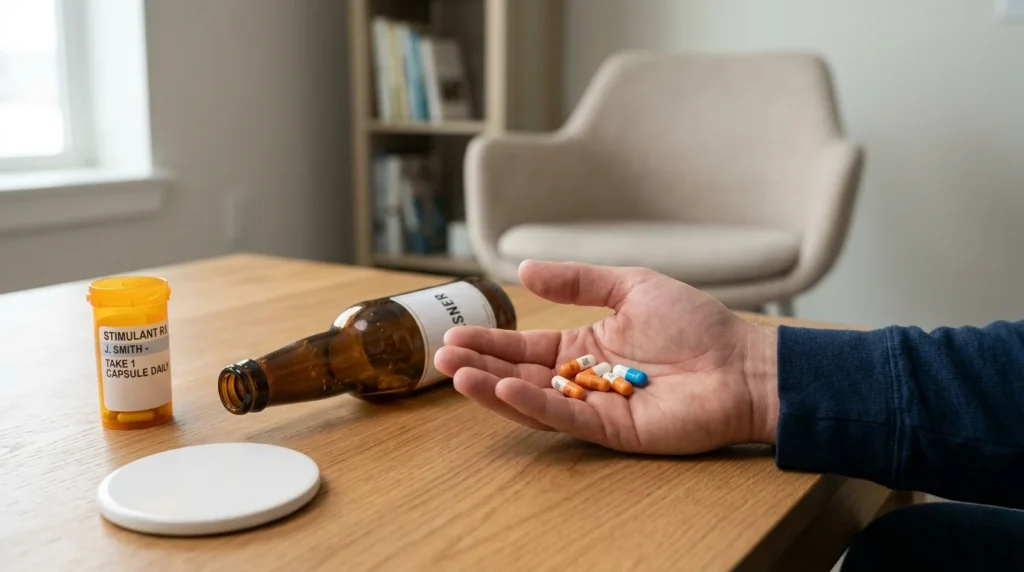
There’s a line between using Adderall and alcohol together occasionally and developing a dependency on the cycle. The brain adapts quickly. What starts as using Adderall to stay awake at a party can become needing Adderall to feel comfortable drinking — and needing alcohol to come down from Adderall. That loop is addiction. And it’s more common than most people think.
Signs that this combination has crossed into substance use disorder territory include:
- Using Adderall specifically to be able to drink more or longer
- Feeling unable to drink socially without Adderall present
- Needing to increase amounts of either substance to get the same effect
- Experiencing [withdrawal symptoms]{.underline} from either substance when you try to stop
- Continuing the behavior despite noticing physical symptoms like heart palpitations or tremors
- Unsuccessful attempts to cut back on your own
If you’re reading this list and something is landing — that matters. Don’t dismiss that recognition.
Client Spotlight
Jordan’s wife called our admissions line after she found him slumped at his desk at 3 a.m., having mixed his Adderall prescription with a significant amount of alcohol over the course of an evening. He had been doing this two to three nights a week for almost a year. He told her he felt completely in control because he never felt “that drunk.” She knew something was wrong but couldn’t name it until she started researching and found information about how Adderall masks alcohol intoxication. Jordan entered our residential program, and the dual diagnosis assessment revealed he’d been managing untreated anxiety for years — which was part of what was driving the drinking to begin with. Treating both changed everything.
How Recreate Ohio Approaches Co-Occurring Substance Use
Here’s what sets our approach apart: we don’t treat Adderall misuse and alcohol use as two separate problems. They arrived together — because the brain and body are experiencing them together — and they need to be addressed together.
At Recreate Behavioral Health of Ohio, our dual diagnosis model integrates assessment and treatment for both substance use disorders and the underlying mental health conditions that frequently drive them. That might be untreated ADHD that led to Adderall addiction. It might be anxiety that alcohol was helping someone manage. It might be both simultaneously.
Our residential program provides 24/7 medically supervised care for people who need to safely detox from alcohol — a process that carries its own serious risks and should never be attempted alone. We offer medication-assisted treatment when appropriate, individual and group therapy grounded in CBT and DBT, and family involvement throughout the process. When residential treatment is complete, we coordinate directly with community partners to support a smooth transition to intensive outpatient care, so recovery doesn’t stop at discharge.
If you’re thinking about how to quit alcohol drinking — or how to stop the Adderall and alcohol cycle altogether — you don’t have to figure out the first step on your own. We do that together.
What Sets Recreate Behavioral Health of Ohio Apart
Our clinical team treats the whole picture. Not just the substance — the person using it, and everything underneath that. Every licensed counselor on staff has completed graduate-level training in behavioral health, and our treatment model is built around the evidence base: CBT, DBT, Motivational Interviewing, and medication-assisted treatment when clinically appropriate.
We’re Joint Commission accredited and licensed by the Ohio Department of Mental Health and Addiction Services. We hold a primary mental health license — which means we can treat co-occurring mental health conditions as standalone diagnoses, not just as a secondary concern attached to addiction treatment.
And we accept most major insurance carriers, including Cigna, Blue Cross Blue Shield, Medical Mutual, and Tricare. Our admissions team verifies coverage directly so you understand what to expect before you commit to anything.
Our serene campus on Olde Ridenour Road in Gahanna provides a quiet, structured environment — away from the triggers and stresses of daily life — where people can focus entirely on getting well. That setting isn’t incidental. It’s part of the clinical approach.
Supporting Articles
- Alcohol Rehab in Gahanna Ohio — An overview of alcohol treatment options available locally, including what the admissions process looks like at Recreate Ohio.
- [Treatment for Prescription Drug Addiction]](/treatment-for-prescription-drug-addiction/) — Explores how prescription drug misuse is assessed and treated, including stimulant medications like Adderall.
- Alcohol Detox Program — A detailed look at what medically supervised alcohol detox involves, why medical oversight matters, and what to expect during withdrawal.
- Dual Diagnosis Treatment Centers in Ohio — Explains how co-occurring substance use and mental health conditions are treated together at Recreate Behavioral Health of Ohio.
- What is Binge Drinking Facts and Health Risks — Covers patterns of heavy alcohol use and the health risks that escalate when other substances are involved.
Frequently Asked Questions
Can I Drink Alcohol If I’m on Adderall?
You shouldn’t mix Adderall and alcohol. Even if your Adderall is prescribed, alcohol can mask how intoxicated you actually are, leading to overconsumption and serious cardiovascular risks. If you have questions about your prescription and alcohol use, speak with your prescribing physician — and if alcohol use has become a concern, reach out for a confidential assessment.
What Does Adderall Feel Like with Alcohol?
Many people report feeling more alert and “less drunk” than they should — which is precisely the danger. The stimulant properties of Adderall suppress the typical signs of alcohol intoxication, creating a false sense of sobriety. Underneath that feeling, your blood alcohol level and cardiovascular strain may be at dangerous levels.
Can You Drink Alcohol While Taking ADHD Medication?
No. Whether you take Adderall, Vyvanse, Ritalin, or another stimulant medication for ADHD, mixing it with alcohol creates the same core danger: the stimulant masks intoxication, increasing the risk of alcohol poisoning, cardiac events, and dependence on both substances. Consult your prescriber before using any alcohol while on stimulant medication.
Can I Drink 12 Hours After Taking ADHD Meds?
Adderall has a half-life of approximately 9–14 hours, which means it may still be active in your system 12 hours later — especially if you took an extended-release formulation. Even after 12 hours, some stimulant activity can remain. The safest approach is to avoid alcohol on any day you take stimulant medication, and to discuss alcohol use directly with your prescriber.
What Cannot Be Mixed with Adderall?
Adderall should not be mixed with alcohol, other stimulants, MAOI antidepressants, or most street drugs. The combination with alcohol is especially dangerous because of the cardiovascular stress and masked intoxication it produces. Anyone taking Adderall — prescribed or otherwise — should discuss all substances and medications with a qualified medical provider.
What Cancels Out the Effects of Adderall?
Nothing safely “cancels out” Adderall once it’s in your system. While alcohol may blunt some of the stimulant’s perceived effects, it does not neutralize Adderall pharmacologically — it simply masks them while adding dangerous physiological stress. There is no safe substance to use for this purpose. If you or someone you know has taken too much Adderall or is experiencing adverse effects, call 911 immediately.
How Do I Know If I Need Treatment for Adderall and Alcohol Use?
If you’re using Adderall to drink more, drinking regularly to come down from Adderall, noticing heart palpitations or blackouts, or have tried to cut back and can’t — those are signs worth taking seriously. A confidential conversation with an addiction specialist can help you understand what you’re dealing with and what level of care might actually help. Reach out to Recreate Behavioral Health of Ohio today.