

For most people, local Ohio rehab is the better starting point — it preserves family connections, keeps insurance straightforward, and removes the logistical barriers that can delay treatment. Out-of-state care makes sense in specific circumstances, but proximity to home is rarely the obstacle people fear it is.
Most people frame this as a geography question. It isn’t. What you’re really asking is: where will I get the best shot at building a life I want to live? That answer depends on your clinical picture, your family situation, your insurance, and what kind of support structure you’ll need when residential treatment ends — not on how many miles you travel.
Recreate Behavioral Health of Ohio has built its program specifically around the recovery outcomes that matter most after discharge. As a facility licensed by the Ohio Department of Mental Health and Addiction Services and holding a primary mental health license — one of the few in Central Ohio — we treat co-occurring addiction and mental health conditions as the integrated challenge they are. Located in Gahanna, Ohio, we offer medical detox, residential treatment, and coordinated step-down care for adults across Ohio and the Midwest.
Why the “Escape” Instinct Is Understandable — but Complicated

There’s a common belief in recovery circles that leaving your environment is essential. Fresh start. New surroundings. No triggers around every corner. And for some people, that logic holds. But it’s worth examining.
Distance doesn’t erase the conditions that fueled addiction. It relocates you. The relationships, the thought patterns, the unaddressed mental health conditions — those travel with you. And when treatment ends, you return to the same community, the same stressors, the same family dynamics. What then?
That’s not an argument against distance. It’s an argument for clarity about why you’re choosing it.
When Out-of-State Treatment Might Make Sense
Some situations genuinely warrant leaving Ohio for treatment:
- High-trigger environments — If your immediate neighborhood, workplace, or social circle is so intertwined with your drug or alcohol use that staying in-state makes early recovery genuinely unsafe
- Need for anonymity — For individuals in high-profile roles or close-knit communities where privacy concerns are legitimate and documented
- Specialized programming — If you have a clinical need (a specific trauma modality, a language-specific program, a specialized dual diagnosis track) that isn’t available locally
- Prior treatment attempts locally — If you’ve completed local programs multiple times and a change of environment is part of a deliberate clinical strategy
None of these are unreasonable. But notice that geography itself isn’t on that list. The reasons are clinical and situational — not that Ohio somehow has worse care than Florida or California.
When Staying in Ohio Makes More Sense
More often than not, staying close to home produces better long-term outcomes — for reasons that are easy to overlook when you’re focused on getting through the front door of treatment.
| Factor | Local Ohio Rehab | Out-of-State Treatment |
|---|---|---|
| Family involvement | Easier — visits, family therapy, natural integration | Difficult — travel costs, scheduling barriers |
| Insurance coverage | Typically smoother, in-network easier to confirm | More frequent out-of-network issues |
| Step-down care coordination | Directly connected to local IOP/OP partners | You return home to unfamiliar providers |
| Support network access | Community connections maintained | Social isolation during treatment |
| Cost and logistics | No travel, no remote accommodation costs | Flights, extended lodging, secondary expenses |
| Post-discharge continuity | Providers who know your history are local | Hand-off to entirely new clinical team |
The bottom right corner of that table is where a lot of out-of-state treatment stories quietly unravel. Discharge is not the end of treatment — it’s a transition point. When your residential program is 1,200 miles from your therapist, your AA meeting, and your family, that transition becomes a cliff instead of a staircase.
The Family Connection Factor

Can your family be involved in your treatment if you go out of state? Technically, yes. Practically, often no.
Family therapy isn’t optional — it’s one of the evidence-based pillars of sustained recovery. Addiction doesn’t happen in a vacuum, and neither does healing. When a spouse, a parent, or a sibling can sit in a family session, participate in education programming, and build their own understanding of what recovery looks like, outcomes improve. Measurably.
Geography makes that harder. A round-trip flight to visit someone in residential treatment in Florida isn’t what most Ohio families can manage weekly — or even monthly.
Client Spotlight
When Anne’s husband entered residential treatment, she was bracing herself to figure it out alone. She’d assumed the clinical side of things would be handled and that her role would be to wait. What she didn’t expect was a call from the family program coordinator on day three, asking when she’d like to come in. Over the next six weeks, Anne attended four family sessions — two in person and two by video — and learned more about the cycle of her husband’s alcohol use than she had in twelve years of living through it. By the time he transitioned to outpatient care, they weren’t starting over as strangers to the process. They were already a team. “I didn’t realize how much I needed to be part of it,” she told his counselor. “I thought this was his work to do.”
Insurance: The Practical Reality Nobody Talks About First
Out-of-state treatment isn’t just more logistically complicated. It’s frequently more expensive in ways people don’t anticipate until they’re already committed.
Ohio-based facilities that are in-network with your insurance carrier will process your benefits at in-network rates. Cross state lines, and that calculation often changes. You may find yourself responsible for a significantly higher deductible, a larger coinsurance percentage, or in some cases, the full bill — because your plan’s out-of-network provisions apply differently than you expected.
This isn’t a reason to stay in Ohio at any cost. But it is a reason to verify your benefits before you choose a facility based on geography or reputation alone.
At Recreate Behavioral Health of Ohio, we work with Cigna, Medical Mutual, Tricare, and other major carriers. Our admissions team verifies coverage directly — so you’re not making a decision this important based on guesswork.
What “Level of Care” Actually Means Here
One thing that often gets lost in the local-vs.-out-of-state conversation is the question of what level of care you actually need.
If you need medical detox, that’s the non-negotiable first step — and it needs to happen in a medically supervised environment regardless of which state it’s in. Alcohol withdrawal and opioid withdrawal aren’t inconveniences you can manage with willpower. They are physiological events that require 24/7 monitoring and, in many cases, medication-assisted treatment to complete safely.
After detox, residential treatment provides the structured therapeutic work — individual therapy, group sessions, dual diagnosis care, evidence-based modalities — that forms the clinical core of recovery. This is where the deeper work happens. And after residential care, the path to outpatient treatment, intensive outpatient programming, and community-based support needs to be coordinated and seamless.
That continuum matters enormously. And it’s easiest to navigate when your residential program is embedded in the same community you’ll return to.
Client Spotlight
Franklin came to residential treatment with a history of opioid use and a depression diagnosis he hadn’t addressed in years. He’d been researching facilities in two other states — drawn in part by glossy websites and in part by a genuine desire to be somewhere no one knew him. What made him call us instead was a single conversation with our admissions team. They asked him about his job, his kids, his mom who lived fifteen minutes away. “They wanted to know about my life,” he said later. “Not just my drug history.” He spent 45 days in residential care, participated in family sessions with his mom, and transitioned directly into IOP with a partner provider his treatment team had worked with for years. He didn’t have to explain himself to a new clinical team at discharge. The people who knew his case helped coordinate what came next.
What the Research Actually Supports
Studies consistently show that aftercare engagement — meaning your participation in outpatient programming, peer support, and ongoing therapy after residential treatment — is one of the strongest predictors of sustained recovery. Not where you went. Not how far you traveled. But whether you stayed connected to support after discharge.
That connection is logistically easier to maintain when your care happened locally.
The Substance Abuse and Mental Health Services Administration (SAMHSA) recommends at minimum 90 days of treatment across the continuum of care. Those 90 days span multiple levels — detox, residential, outpatient. Each transition is a vulnerability point. Each one is navigated more successfully when your providers know each other and your community is nearby.
What Sets Recreate Behavioral Health of Ohio Apart
Choosing local doesn’t mean choosing second-best. The question worth asking isn’t whether to stay in Ohio — it’s whether the Ohio program you’re considering can actually deliver what you need.
Our clinical team at Recreate Ohio provides dual diagnosis treatment as a specialty — not as an add-on. We hold accreditation from the Joint Commission and a primary mental health license from the state of Ohio, allowing us to treat individuals whose primary diagnosis is a mental health condition like depression, PTSD, or bipolar disorder, independent of substance use. That’s a meaningful distinction. Most residential programs treat addiction first and mental health second. We don’t separate them — because the research doesn’t support separating them.
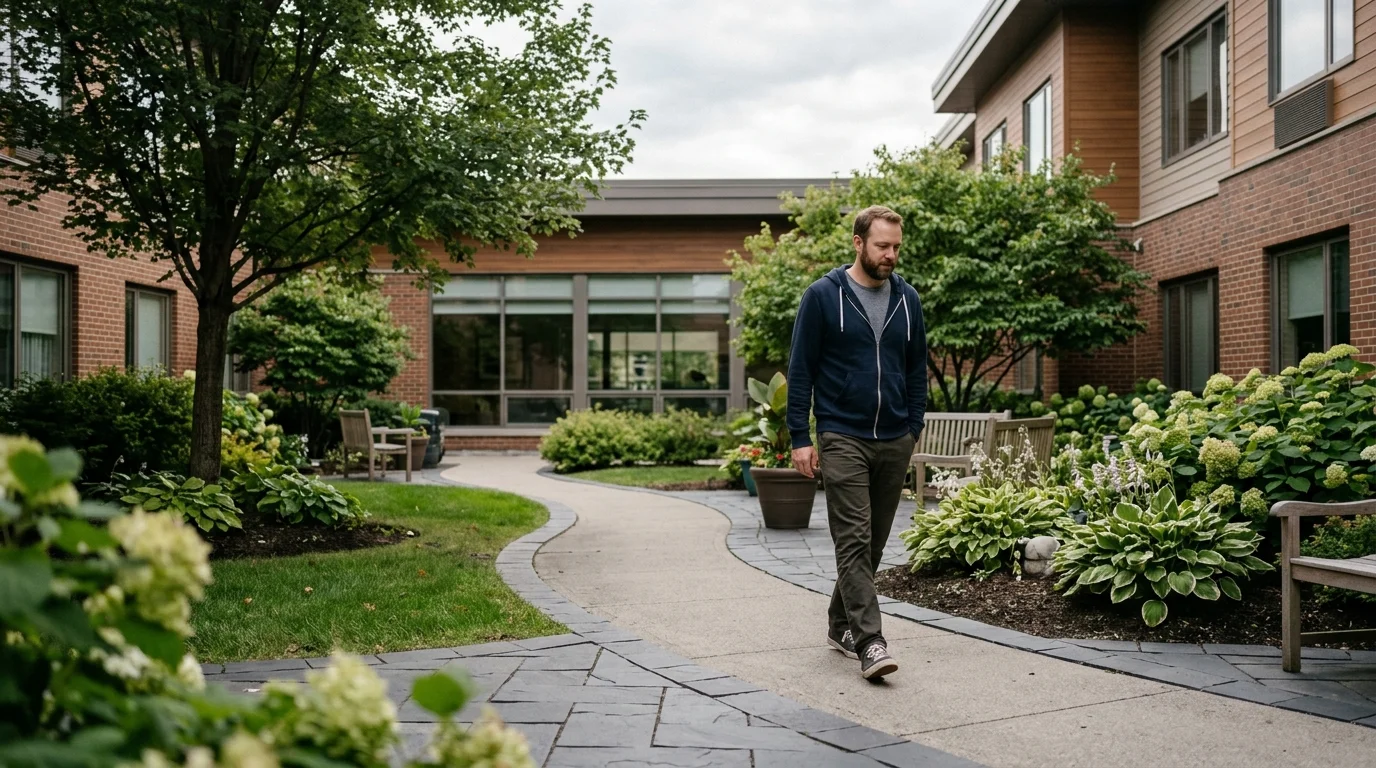
We’re also part of the Recreate Behavioral Health network, which brings national clinical depth to a program with real Ohio community roots. Our campus in Gahanna sits in a quiet, peaceful setting that supports the kind of concentrated focus recovery requires — while keeping you connected to the Columbus-area community you’ll be returning to.
Discharge is something we prepare for from day one. We coordinate directly with outpatient partners so that when residential treatment ends, the next phase of your care is already arranged — not something you figure out on your own two weeks later.
Supporting Articles
- Residential Addiction Treatment Ohio — A detailed look at what residential treatment involves and who benefits most from this level of structured care.
- Addiction Treatment in Ohio — An overview of the treatment options available in Ohio, from detox through outpatient programming and long-term recovery support.
- Dual Diagnosis Treatment Centers in Ohio — Why treating addiction and mental health conditions together produces better outcomes, and what integrated care actually looks like in practice.
- Intensive Outpatient Program Ohio — What to expect from IOP as a step-down from residential treatment, and how it fits into a continuum of care.
- Addiction Recovery Process — A guide to the stages of recovery and what changes at each level of care as you move from detox through long-term sobriety.
Frequently Asked Questions
Yes — clinical effectiveness is determined by the quality of care, not the state it’s delivered in. Ohio has accredited, evidence-based residential programs that match the clinical standards of facilities anywhere in the country. What matters most is the treatment model, the dual diagnosis capability, and the post-discharge support structure, not the geography.
Triggers are internal as much as they are environmental. Evidence-based therapies like cognitive behavioral therapy and dialectical behavior therapy work by building your capacity to respond differently to triggers — not by eliminating them. Residential treatment creates the protected space to do that work, regardless of location. Most people return to the same communities after treatment and recover successfully.
Often, yes — and usually in favor of staying local. In-network providers in your home state are more commonly aligned with your insurance carrier’s coverage structure. Out-of-state treatment frequently triggers out-of-network rates, which can significantly increase your out-of-pocket costs. Always verify your benefits before choosing based on location.
Relapse doesn’t mean local treatment failed you — it means the work isn’t finished yet. Returning to treatment is a sign of self-awareness, not defeat. If previous attempts haven’t addressed underlying mental health conditions, a dual diagnosis program may produce substantially different outcomes than a purely addiction-focused one.
Significantly. Family therapy and family education programming are evidence-based components of recovery. Geographic distance makes consistent family participation difficult and costly. When treatment happens locally, spouses, parents, and siblings can participate meaningfully — which improves outcomes for everyone involved, not just the person in treatment.
With a locally based program, your step-down care is coordinated through community partners who operate in the same area you’ll be returning to. At Recreate Ohio, we arrange outpatient transitions before discharge — so you don’t navigate that hand-off alone or have to introduce yourself to an entirely new clinical team in a different state.
Privacy is a legitimate concern, and it’s worth discussing directly with the admissions team of any program you’re considering. Reputable treatment facilities — including those in Ohio — follow strict confidentiality protections under HIPAA. If privacy is your primary concern, it’s worth exploring whether local options can meet that need before assuming distance is the only solution.